
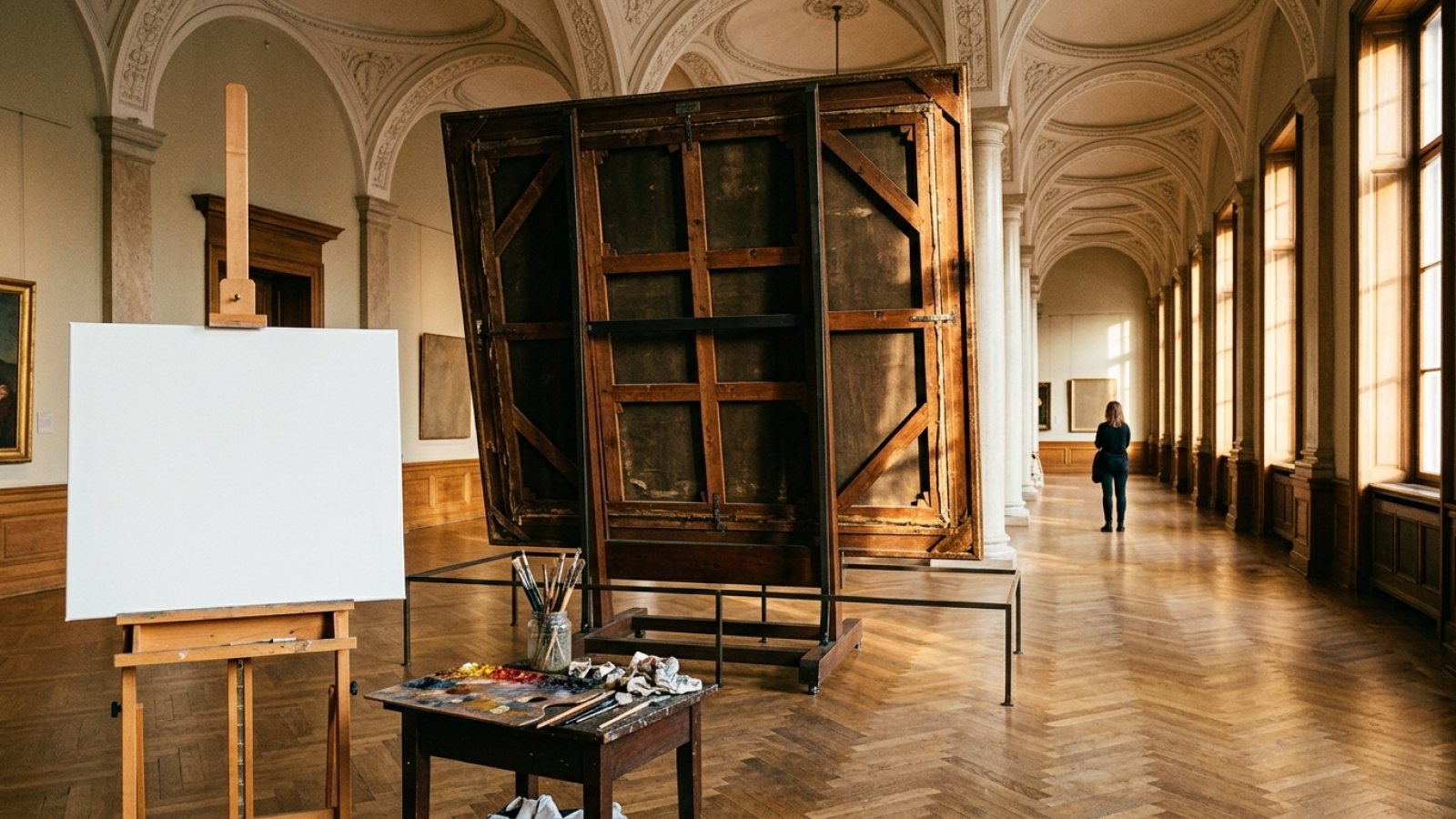
No canvas in art history quite stares back at you with the disarming intensity of Diego Velázquez’s 1656 masterwork, Las Meninas, housed in Madrid’s Museo del Prado. It is a painting that not only depicts a scene from the Spanish court but also brilliantly, daringly, depicts itself being painted, pulling the viewer into an intricate web of observation and representation. Here, what is recursing is the very act of artistic creation: Velázquez has placed himself directly into the composition, brush in hand, confronting an unseen canvas and, by extension, the viewer.
The Infanta Margarita stands front and center, bathed in the cool light of the Alcázar’s grand studio, surrounded by her retinue of maids of honor (the 'meninas'), dwarfs, and a sleepy mastiff. Yet, the true focal point is not the royal child, but the towering figure of Velázquez himself, on the far left. He stands before a colossal canvas, his gaze fixed outward, seemingly at a reflection or at an absent presence that aligns precisely with our own vantage point. This is the audacious trick: the King and Queen, Philip IV and Mariana of Austria, whose stately reflection appears in a distant mirror on the back wall, are the supposed subjects, and we, the viewers, are invited to share their perspective. Why it matters is that Velázquez doesn't just show us a court scene; he pulls back the curtain on the mechanics of art-making, asserting the artist’s intellectual prowess and crucial role in shaping perception.
The Artist as Subject and Observer
Velázquez’s inclusion of himself is more than a simple self-portrait. It’s an assertion of status, a profound philosophical statement on the act of seeing and being seen. By presenting himself in the act of painting the very scene we witness, he collapses the traditional boundary between observer and observed. The canvas within the canvas, its back turned to us, is a monumental presence that simultaneously reveals and conceals. It forces us to acknowledge the artificiality of the image while simultaneously immersing us in its illusion. This recursive loop—the painter painting himself painting the painting—transforms Las Meninas from a mere portrait into a visual treatise on reality, illusion, and the artist’s god-like ability to conjure worlds.
The painting’s enduring power lies in this multi-faceted dialogue. Whose perspective are we truly sharing? Are we the absent monarchs, reflected imperfectly in the mirror, or are we simply other members of the court, privileged to witness this intimate moment? Velázquez, through this deliberate ambiguity, makes us active participants in the scene, forcing us to question our position, the act of looking, and the very nature of what is being depicted. This self-referential quality, which was revolutionary for its time, established a new paradigm for how artists could engage with their subjects and their audience, laying groundwork for centuries of artistic experimentation.
Echoes Through the Centuries
The profound recursions within Las Meninas have resonated deeply with artists across generations. Francisco Goya, in his 1800 family portrait The Family of Charles IV, famously echoed Velázquez’s compositional device, placing himself at his easel within the painting, peering out at the viewer. Though Goya's take carried a different critical edge, the homage to the master's self-insertion is unmistakable. Later, Pablo Picasso dedicated 58 canvases to reinterpreting Las Meninas in 1957, deconstructing and reconstructing Velázquez’s original with cubist fervor, each variation a conversation with the source. Each stroke by Picasso was a recursive act, painting a painting about a painting of a painter painting. In these homages, what is recursing is not just the original composition, but its very spirit of self-reflexivity, compelling artists to engage with the past while pushing the boundaries of their own present.
Even in contemporary art, the ghost of Las Meninas lingers, influencing discussions around appropriation, representation, and the artist's role. It remains a touchstone for works that question their own making or feature the artist as an integral, visible part of the creative process. From the quiet galleries of the Prado in Madrid to the bustling studios of contemporary artists, the painting continues to challenge and provoke, proof that some works never truly conclude their conversation with us.
Las Meninas ensures that every viewer, whether standing before the original in Madrid or contemplating a reproduction, becomes a part of its eternal gaze, caught in the endless loop of the artist painting the painting, endlessly reflecting on the act of seeing itself. The masterpiece doesn't just hang on the wall; it actively observes, questioning our presence as much as we question its own.
