
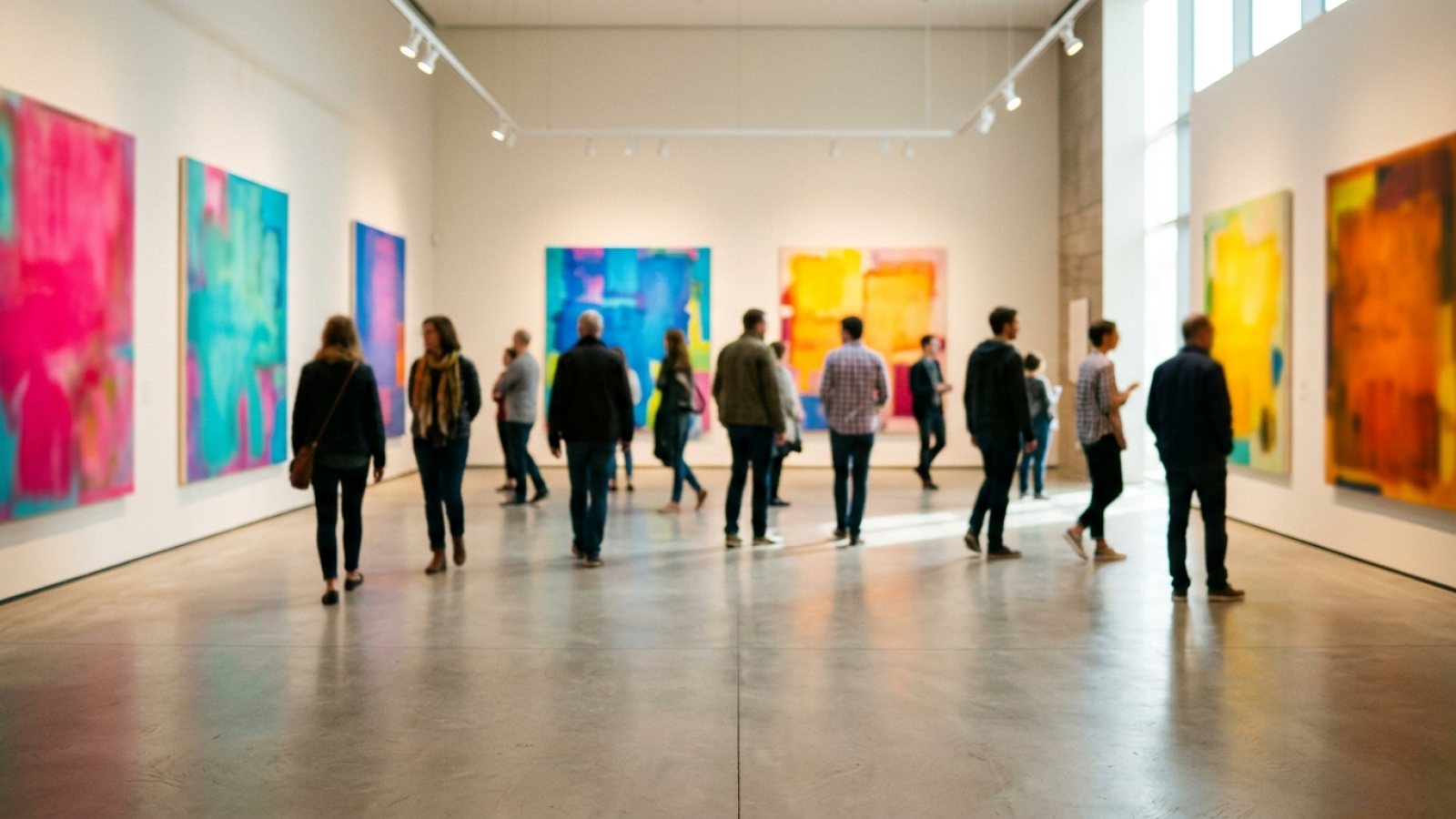
Andy Warhol is often imitated, and never more so than in his renditions of film legend Marilyn Monroe. So it comes as no surprise that several artists have now paid tribute to Warhol, the art icon, in his tributes to Marilyn, the film icon. It is a dizzying hall of mirrors perfectly suited for our library of recursions here at Art Within Art. We are looking at a painting of people looking at paintings of a print of a photograph of a woman playing a carefully constructed part. It is a Russian nesting doll of observation.
The Niagara Matrix
To understand the layers of homage at play, we must return to the source material. Warhol began his iconic Marilyn silkscreens in 1962, shortly after the actress's tragic death. He did not paint her from life, nor did he seek to capture her unvarnished soul. Instead, he lifted a black-and-white publicity still from her 1953 thriller, Niagara. By flattening her recognizable features and drowning them in aggressively synthetic inks, Warhol transformed a vulnerable human being into an indestructible brand. He stripped away the tragedy and left only the brightly packaged commodity.
This is the bedrock of the pop art movement: the defiant elevation of the mass-produced image to the revered realm of high art. But what happens when that high art becomes so ubiquitous that it essentially becomes mass media all over again? The art world loves a sophisticated echo chamber, and contemporary painters have found endless fascination in turning Warhol’s own detached lens back upon his monumental legacy.
Spectators in the Frame
Enter the 2008 oil on canvas Marilyn By Me Exhibit by K Madison Moore. Here, the recursion is stated with charming, literal clarity. What is the art inside the art? An entire gallery space. Moore has painted an exhibition room lined with vibrant, Warhol-esque portraits of Marilyn Monroe, complete with miniature gallery visitors observing the works. The artist places the viewer squarely behind the velvet rope, forcing us to watch the watchers.
Why does this specific recursion matter? Because it deliberately shifts the subject of the artwork from the celebrity herself to the spectacle of our own visual consumption. Warhol showed us Marilyn as a flat, vibrant product; Moore shows us the museum-going public eagerly consuming that product. The painted visitors stand in for us, the real-world audience. By depicting a public exhibition rather than just painting another standalone portrait of Monroe, the painter captures the social architecture of the art world itself. The gallery space becomes a charming diorama of modern reverence.
It is a witty, knowing commentary on how we actually experience famous art today. We rarely encounter a masterpiece in a silent, solitary vacuum. Instead, we see it over the shoulders of shuffling tourists, surrounded by the hushed hum of a crowded room. Moore freezes that communal, slightly distracted energy on canvas, reminding us that art is as much about the environment of display as it is about the object on the wall.
An Infinite Regression
There is a warm irony in taking oil paint—the traditional, painstaking medium of the Old Masters—and using it to depict the mechanical, rapid-fire silkscreens of the Pop era. The artist slows down the frantic pace of modern celebrity worship, gently demanding that we pause and really look at the act of looking. It is an invitation to consider how icons are curated long after their creators have left the stage.
In this continuous loop of pop culture history, the 1953 studio photographer captured a glamorous starlet. Warhol captured the photograph. Moore captures the gallery showing the ghost of that photograph. And we, the final viewers, stand outside the canvas, completing the circuit with our own gaze. It is the ultimate testament to Monroe’s enduring, shape-shifting power. She is no longer just a film legend; she is a timeless motif that painters will continue to hang on the walls of their imaginations for decades to come.
