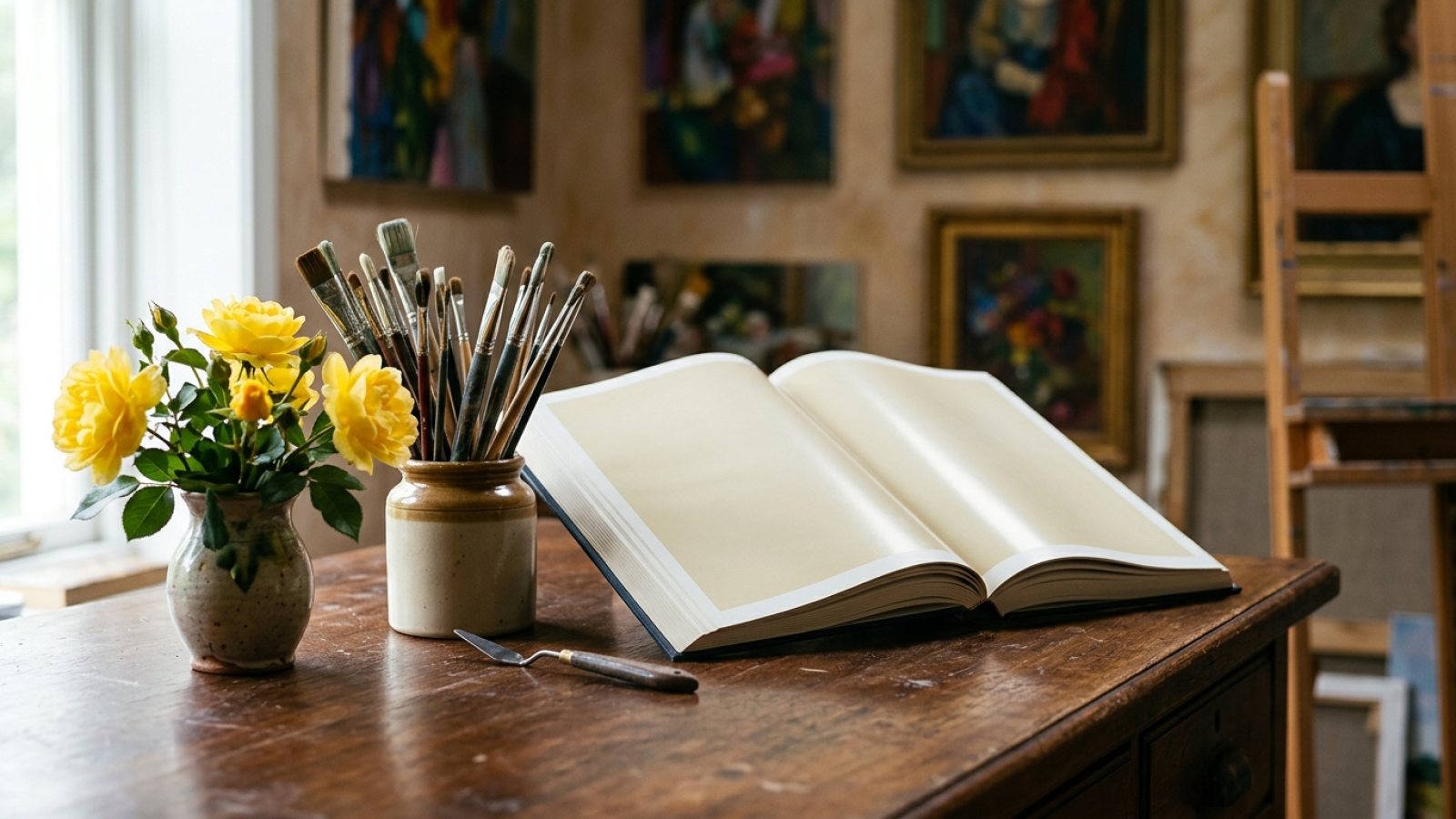
There is a polite fiction in the art world that we all spend our weekends strolling through the echoing halls of the Louvre or the Met, absorbing the canon directly from the canvas. The truth, of course, is far more domestic. We learn art history from the heavy, glossy pages of monographs resting on our laps or our coffee tables. Eugene Wang’s Still Life with Yellow Rose and Book—a modest, masterful oil measuring just 12 by 14 inches—captures this exact reality with a knowing wink. The artist presents a familiar desktop tableau: yellow roses in a vase, a jar bristling with paintbrushes, and an open art book.
The Canvas Within the Page
Here is the recursive hook, stated as plainly as a martini order: Wang has created an oil painting that features a printed book, and the pages of that book display mechanical reproductions of other paintings. We are looking at a painting of a print of a painting. It is an exquisite visual loop that plays with the very fabric of how imagery is transmitted across generations. When the cultural critic Walter Benjamin famously fretted over the work of art in the age of mechanical reproduction, worrying that the aura of the original would be lost once it was printed by the thousands, he could not have anticipated this charming rebuttal. Wang playfully reverses that anxiety.
Why does this particular recursion matter? Because it performs a miraculous act of alchemy. By rendering the mass-produced pages of a book in rich, singular oil paint, the artist restores the lost aura to the reproduction. The flattened, printed masterpieces on the book’s pages are pulled back into the realm of the unique, handmade object. Wang is not just depicting an art book; the painter is elevating our everyday, second-hand consumption of art back to the status of high art itself. It is a quiet but thrilling subversion of the hierarchy between the museum original and the bookstore copy.
The Audience of Brushes
To understand the full wit of the piece, one must look at the company the book keeps. Beside the open pages sits a jar of paintbrushes and a vase holding yellow roses. The roses offer a nod to the Dutch Golden Age, a polite whisper of the traditional vanitas reminding us that flowers will fade, but art remains. Yet, it is the jar of brushes that provides the scene’s true narrative tension. The brushes stand at attention, leaning slightly toward the open book as if they are studying the reproductions.
In a way, they are the audience. The tools of the painter’s trade are resting, taking a moment to look back at the history of their own medium. There is a profound warmth in this arrangement. The artist acknowledges that every creator is, first and foremost, a student and a fan. Before the brush touches the canvas to create something new, it must sit on the desk beside the giants of the past, absorbing the lessons printed on glossy paper.
An Intimate Scale
At merely 12 by 14 inches, Still Life with Yellow Rose and Book does not shout across a cavernous white-cube gallery. It demands that you step close, narrowing your physical distance until your view mirrors the perspective of someone sitting at that very desk. You are forced to peer into the painted book just as you would read a real one.
This intimate scale is essential to the painting’s success. It reminds us that our most profound encounters with art history are rarely public spectacles; they are private, quiet moments of discovery. By painting a book of art, Wang honors the silent, stationary journey of looking. The work leaves us with a provocative, lingering thought: perhaps the true home of a masterpiece is not on a museum wall, but in the mind of the painter who studies it, translates it, and eventually paints it all over again.
