
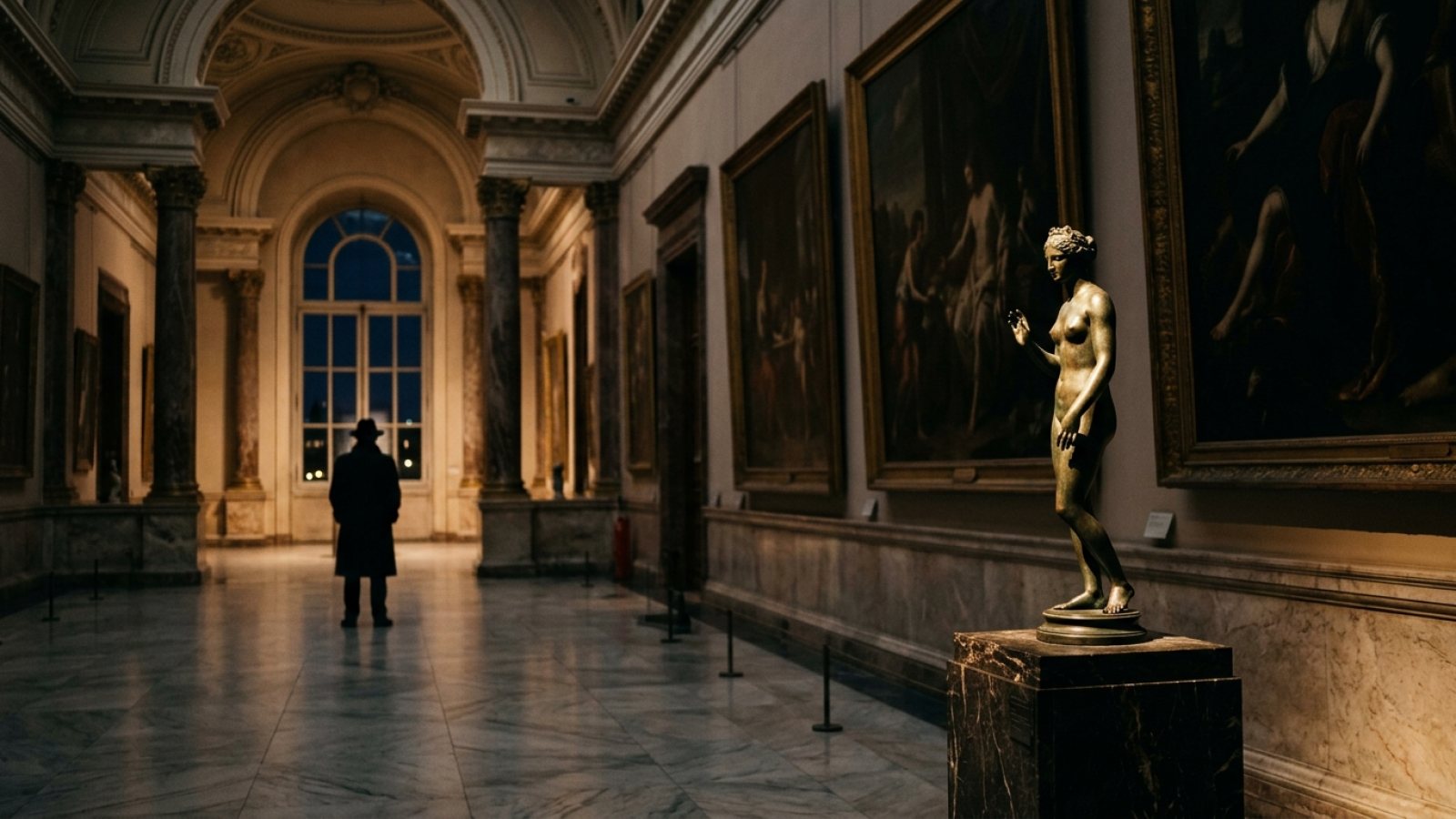
William Wyler’s 1966 caper How to Steal a Million goes down like a perfectly chilled martini at the Bemelmans Bar. It is a film of effortless mid-century glamour, starring Audrey Hepburn and Peter O'Toole, set against the intoxicating backdrop of a mythic, stylish Paris. But beneath the Givenchy lace and the sparkling banter lies a surprisingly sharp meditation on authenticity, pedigree, and the nature of illusion.
Here at Art Within Art, we are obsessed with the meta-narrative. In Wyler’s film, the recursion is as elegant as it is explicit. What is recursing? A Hollywood fiction built entirely around the creation, exhibition, and ultimate theft of forged masterpieces. The art inside the art is a collection of fake masterworks, most notably a statuette billed as the legendary Cellini Venus, all originating from a single, exceedingly polite Parisian household.
The Family Business
Hepburn plays the devoted daughter of an unapologetic gentleman forger. Her father is not a common street criminal, but a passionate, tweedy craftsman who churns out flawless paintings in the manner of the great masters from the comfort of their mansion. He is an artist whose only sin is signing the wrong name. The trouble begins when he allows his prized family possession—the exquisite Cellini Venus statuette, sculpted by his own father—to be exhibited at a major Paris museum.
When the museum decides to subject the Venus to a rigorous insurance examination, the jig is nearly up. Modern science threatens to expose the classical masterpiece as a rather charming contemporary fraud. To protect her father from ruin and a lengthy prison sentence, Hepburn’s character does what any sensible, impeccably dressed Parisian would do: she hires a handsome burglar, played by O'Toole, to steal her own family's forgery right out of the heavily guarded museum.
The Recursion of the Fake
This brings us to why it matters. How to Steal a Million is an illusion wrapped in a fraud, wrapped in a heist. Cinema itself is the grandest forgery of all—a mechanical manipulation of light and time designed to convince the eye of a reality that simply does not exist. By centering the plot on a forged sculpture masquerading as a Renaissance treasure, Wyler winks broadly at his audience. He asks us to suspend our disbelief for the film, while simultaneously asking us to root for a literal fake within the story.
The museum heist sequence is a masterclass in tension and comedy, but it is also a brilliant piece of staging. The museum, a temple of cultural truth and historical preservation, is compromised not by the theft of a priceless artifact, but by the presence of a completely worthless one. The institution's authority is entirely undermined by the forger's brush and chisel. The recursion matters because it challenges our inherent, often tiresome snobbery about provenance. If a painting or a sculpture is beautiful enough to move the public, convince the critics, and inspire a daring midnight robbery, does it really matter whose hands shaped it?
Stealing the Illusion
O'Toole and Hepburn glide through this ethical gray area with the kind of sophisticated detachment that makes you long for an era when crimes were solved with a cocktail shaker rather than a DNA swab. The film does not condemn the forger; if anything, it celebrates his sheer audacity. The real villains of the piece are the pedantic insurance men and the stuffy institutional experts who care more about a piece of paper verifying an artwork’s age than the aesthetic pleasure it provides to the viewer.
In the end, the stolen Venus represents the triumph of a good story over cold, hard facts. It is a philosophy that perfectly mirrors the magic of the movies. We do not go to the cinema for absolute truth; we go to be enchanted. Wyler’s masterpiece reminds us that sometimes, a brilliant fake is far more valuable than a tedious reality. The art within the art is a lie, but it is a lie that tells a delightful truth about why we need art in the first place.
