
Smooth, polished surfaces. Meticulous attention to detail. Flawless and seemingly lifelike. These are words we often use when describing the great Dutch Masters of the seventeenth century. That era also marked the emergence of genre scenes—paintings of everyday life with people depicted in settings at home, in commerce, or at leisure. Influenced by those great predecessors and trained rigorously in their classical techniques, contemporary Dutch artist Gerard Boersma has emerged as both a masterful hyperrealist painter and a keen observer of modern everyday life. But where the Old Masters gave us milkmaids pouring milk and merchants weighing coins, Boersma gives us the contemporary art gallery. It is a brilliant pivot. The artist takes the historical weight of Dutch realism and applies it to the modern white-cube space, replacing the tavern with the exhibition hall. The painter turns the sharp, unblinking eye of the Dutch tradition onto the very people who consume it.
The Art Inside the Art
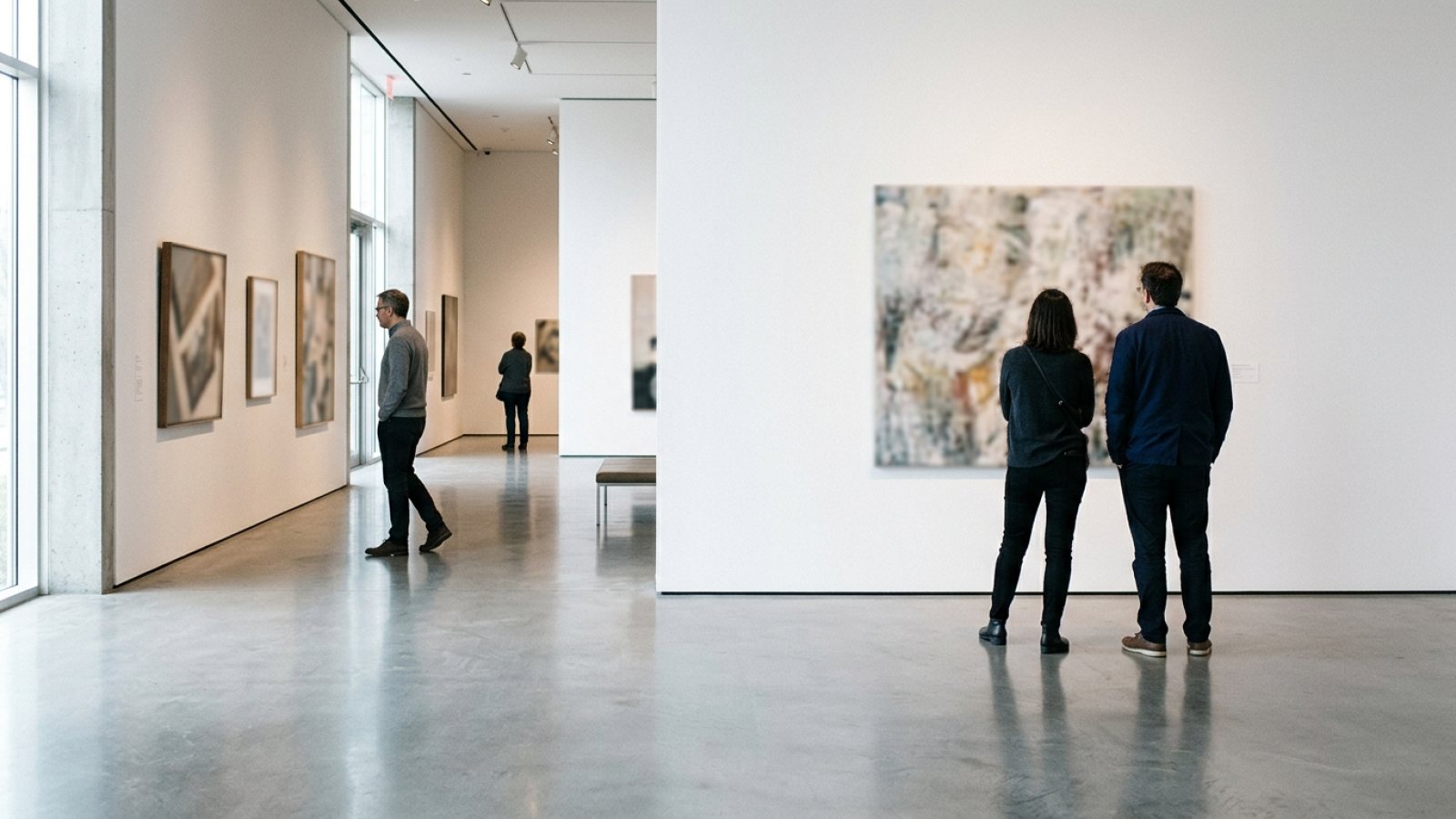
The recursion in Boersma’s work is both immediate and deliciously meta. In the painting The Circle, the artist depicts gallery visitors, some seated on benches and others standing, pausing before paintings hung on a pristine gallery wall. The art within the art is the collection of framed canvases rendered inside the composition. We, the viewers, are looking at a painting of viewers looking at paintings. It is a hall of mirrors constructed entirely out of oil paint. The recursion turns a simple painting into a psychological loop. What is recursing here is the physical artwork on the fictionalized exhibition wall, but what truly matters is the recursion of the gaze itself. Why does this matter? Because it forces us to become acutely aware of our own posture, our own quiet contemplation, and our own participation in the ecosystem of the art world. We are caught in the act of looking, suddenly conscious of the space we occupy in the room.
Mirrors of the White Cube
The Chelsea or Midtown Manhattan gallery crawl is a familiar weekend ritual, complete with the hushed tones, the resting gallery face, and the occasional sigh of aesthetic fatigue. Boersma captures this specific atmosphere perfectly. There is no snobbery here, only a wry affection for the rituals of the art crowd. Through a photorealist lens, the painter elevates the mundane act of museum-going into a subject worthy of the same rigorous, flawless execution that seventeenth-century masters applied to their most exalted subjects. The viewer standing in The Circle is not just a prop; they act as a direct surrogate for us. The paintings on the painted wall are rendered with enough fidelity to remind us of the commerce and leisure of the contemporary art market, yet they remain secondary to the human subjects observing them. The irony, of course, is a delightful one: a collector might buy The Circle to hang on a prominent wall, only for their guests to stand before it, perfectly mimicking the painted figures trapped within the frame. It is an endless loop of cultural consumption.
Updating the Dutch Tradition
Photorealism often risks feeling cold, a mere parlor trick of technical proficiency. Yet, under the brush of this contemporary Dutch painter, the hyperrealist method feels remarkably warm and knowing. Boersma uses the exacting standards of classical training not just to replicate reality, but to comment playfully on how we interact with culture today. The modern gallery space is the contemporary equivalent of the seventeenth-century courtyard or market square—a public theater designed to see and be seen, to consume and to contemplate. By embedding art within art, Boersma creates a self-aware genre scene tailored for the twenty-first century. The paintings on the wall inside The Circle serve as the anchor for the quiet human drama unfolding in front of them. Ultimately, the artist proves that the most fascinating thing happening in a museum isn't always what is hanging on the wall, but the profound, everyday theater of the people standing right in front of it.
