
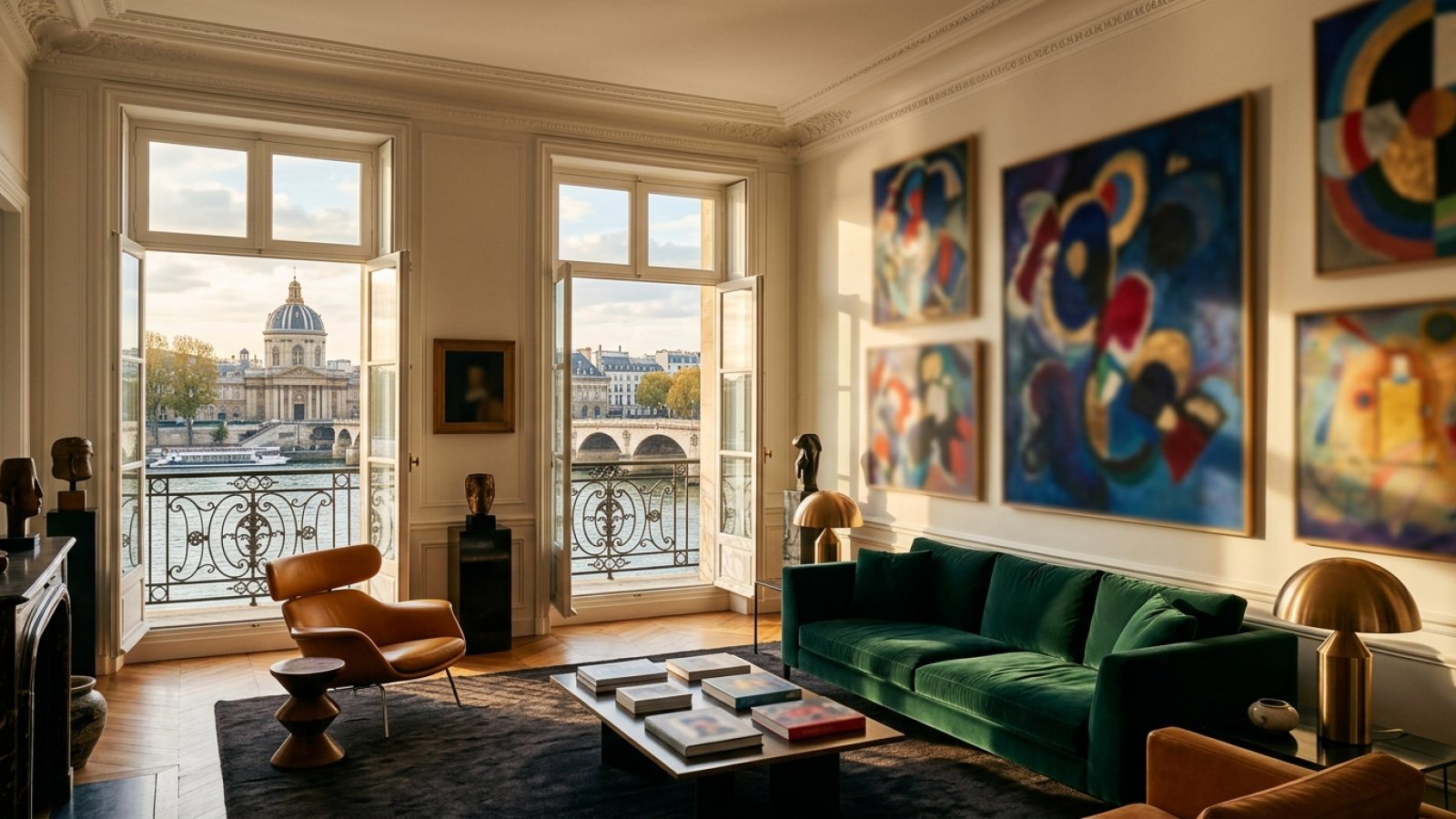
Picture this – a charming pied-à-terre overlooking the Seine River in Paris with original artwork by Chagall, Picasso, and Matisse adorning its walls. Prefer New York? A vibrant flat awaits you overlooking Central Park with an art collection containing works by the masters of modern art. Born Francois Ledan, but known the world over simply as Fanch, Monsieur Ledan has charmed us all with his whimsical and at times slightly surreal portraits of home interiors that rival those found in Architectural Digest.
But Fanch does not merely paint furniture and floor plans; he is an architect of the ultimate collector’s fantasy. As a painter and printmaker, he has carved out a fascinating niche in the world of recursive art: the domestic gallery. He paints rooms that contain other paintings, specifically recognizable, iconic masterworks of the twentieth century. It is a visual nesting doll that invites us to step out of the crowded museum and into the serene living room.
The Ultimate Collector's Fantasy
Here at Art Within Art, our cardinal rule is to identify exactly what is recursing and why it demands our attention. In Fanch’s world, the what is deliciously straightforward. He meticulously renders miniature versions of famous canvases by modern masters, hanging them gracefully within his own painted architectural spaces. Take, for example, his wonderfully evocative Interior with Lichtenstein (and a strong nod to Peter Max). The canvas presents a crisp, inviting room where the unmistakable Ben-Day dots of a Roy Lichtenstein masterpiece hold court on the wall, while the vibrant, psychedelic color palette of Peter Max influences the surrounding decor.
The why, however, is where Fanch’s true brilliance lies. Why place a Lichtenstein inside a Ledan? Because doing so fundamentally changes our relationship to the masterpiece. In a major institution, a blue-chip painting is a holy relic, cordoned off by velvet ropes and guarded by stern men in dark suits. By transplanting these iconic works into fictional, private living spaces, Fanch democratizes the experience of high art. He strips away the intimidation of the gallery wall and replaces it with the warmth of a well-appointed home. The recursion allows us to possess the unpossessable.
The Museum as a Pied-à-Terre
There is a knowing, Midtown Manhattan wink to this entire endeavor. We all harbor a secret desire to live alongside genius, to sip our morning espresso while casually gazing at a Matisse that happens to be hanging above the sofa. Yet, for most of us, our budgets restrict our collecting to the museum gift shop. Fanch playfully bypasses the auction houses altogether. He hands us the keys to a multimillion-dollar penthouse and graciously leaves the priceless art collection intact.
Furthermore, this artistic recursion shifts the narrative weight of the room. Notice how Fanch’s interiors are almost always devoid of human occupants. In the absence of people, the paintings on the wall become the undisputed protagonists of the space. The Chagall or the Picasso is no longer just a decorative object; it is the room’s primary resident. The art converses silently with the sleek modern furniture, the carefully placed houseplant, and the sweeping metropolitan view just outside the window.
A Surreal Sense of Place
Fanch’s work often flirts with a slightly surreal edge, precisely because these rooms are too perfect, too serene. They are psychological landscapes as much as they are architectural ones. The recursion of placing a famous artwork within his own canvas serves to anchor these dreamlike spaces in a shared cultural reality. We might not recognize the fictional apartment, but we instantly recognize the Picasso. The masterpiece becomes a familiar friend in an unfamiliar, idealized setting.
Ultimately, Fanch Ledan reminds us that art is meant to be lived with, not merely visited on a Sunday afternoon. Through his clever use of recursion, he proves that a painting changes its very soul when it is brought indoors and given a home. He captures the profound romance of the private collection, allowing us to inhabit a world where the greatest triumphs of modern art are just a glance away from the dining room table.
