
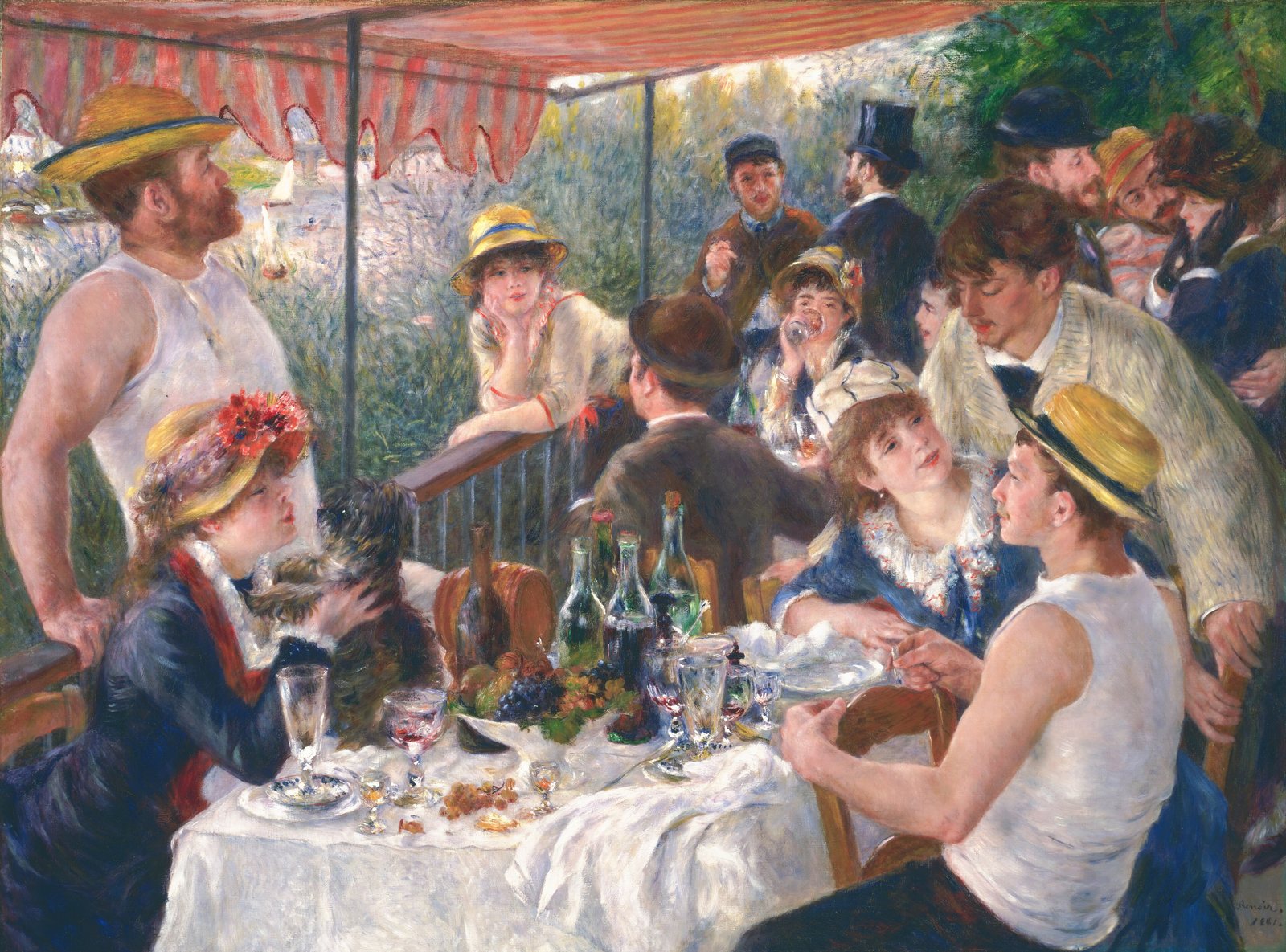
Pictured: Pierre-Auguste Renoir, Luncheon of the Boating Party, 1880–81, The Phillips Collection, Washington, DC.
Pierre-Auguste Renoir’s Luncheon of the Boating Party (1880–81) is a masterclass in the casual, devastatingly French glance. Set on the sun-dappled balcony of the Maison Fournaise restaurant at Chatou on the Seine, the canvas captures a golden afternoon of wine, grapes, and flirtation. The painter's friends lean and converse under a flapping awning. In the foreground, Aline Charigot—destined to become Renoir’s wife—coos at an impossibly small dog. It is an image of perfect, hermetically sealed leisure. When Duncan Phillips purchased the canvas in 1923, he secured the crown jewel of The Phillips Collection in Washington, DC, ensuring generations of Americans could press their noses against the glass of Parisian bohemianism.
The painting is no stranger to being watched, nor to being reproduced. Cinephiles will recall its central, obsessive role in Jean-Pierre Jeunet’s 2001 film Amélie, where a reclusive neighbor spends decades painting copies of this very canvas, endlessly analyzing the disconnected gaze of the guests. But here at Art Within Art, we are interested in a different kind of echo. The recursion in this instance is the depiction of Renoir's canvas as a physical, revered object in contemporary paintings and photography. It matters because framing the Luncheon within new art shifts our focus from nineteenth-century leisure to the modern theater of art appreciation. The watchers on the canvas are suddenly outmatched by the watchers in the gallery.
The Painted Spectator
Edward Burton’s The Art Lover (2009, oil on linen panel) stages this modern dynamic with quiet, deliberate precision. Burton paints a gallery visitor standing squarely before the Renoir, entirely absorbed by the masterwork. The contemporary viewer is pulled into the exact same visual plane as the nineteenth-century boaters. Burton sets up a delicious, ironic dialogue between the solitary, hushed posture of the modern art lover and the crowded, noisy conviviality of the balcony at Chatou. The painting within the painting becomes a vibrant portal, contrasting our often isolated contemporary existence with Renoir’s bustling social web.
Fred Kepler takes a different, equally fascinating approach with Renoir's Boating Party (2010, oil on gessoed masonite panel). Kepler renders the masterpiece anew, translating the original oil into a fresh material language. By repainting the painting, the artist pays homage not merely to Renoir's original composition, but to the enduring, magnetic pull the canvas exerts on the contemporary imagination. It is a rigorous act of artistic devotion, proving that some parties are simply too good to leave in the past.
The Camera's Eye
The gallery experience is, fundamentally, a performance. We do not just look at art; we perform the act of looking, adopting the solemn poses of the culturally enriched. Contemporary photographers Craig James and Andrew Werth separately capture this phenomenon, framing visitors in the act of admiring the canvas in the famously intimate rooms of the Phillips.
In these photographs, the Luncheon functions as a luminous, grand backdrop for twenty-first-century life. The photographers document the museum-goers, turning everyday tourists into unwitting extras in Renoir’s extended, century-spanning scene. The recursion here matters deeply because it highlights the modern museum as a sanctuary of observation. The painted patrons observe Aline Charigot and her dog; the gallery visitors observe the painted patrons; James and Werth observe the gallery visitors.
The layers of looking fold in on themselves effortlessly. Renoir painted his friends enjoying a fleeting moment of connection over wine and fruit. A century later, contemporary painters and photographers capture strangers trying to connect with that very same moment. It is a brilliant, endless loop of admiration. A canvas that was once a simple window into a riverside restaurant has become a mirror, reflecting our own enduring desire to be invited to the party.
