
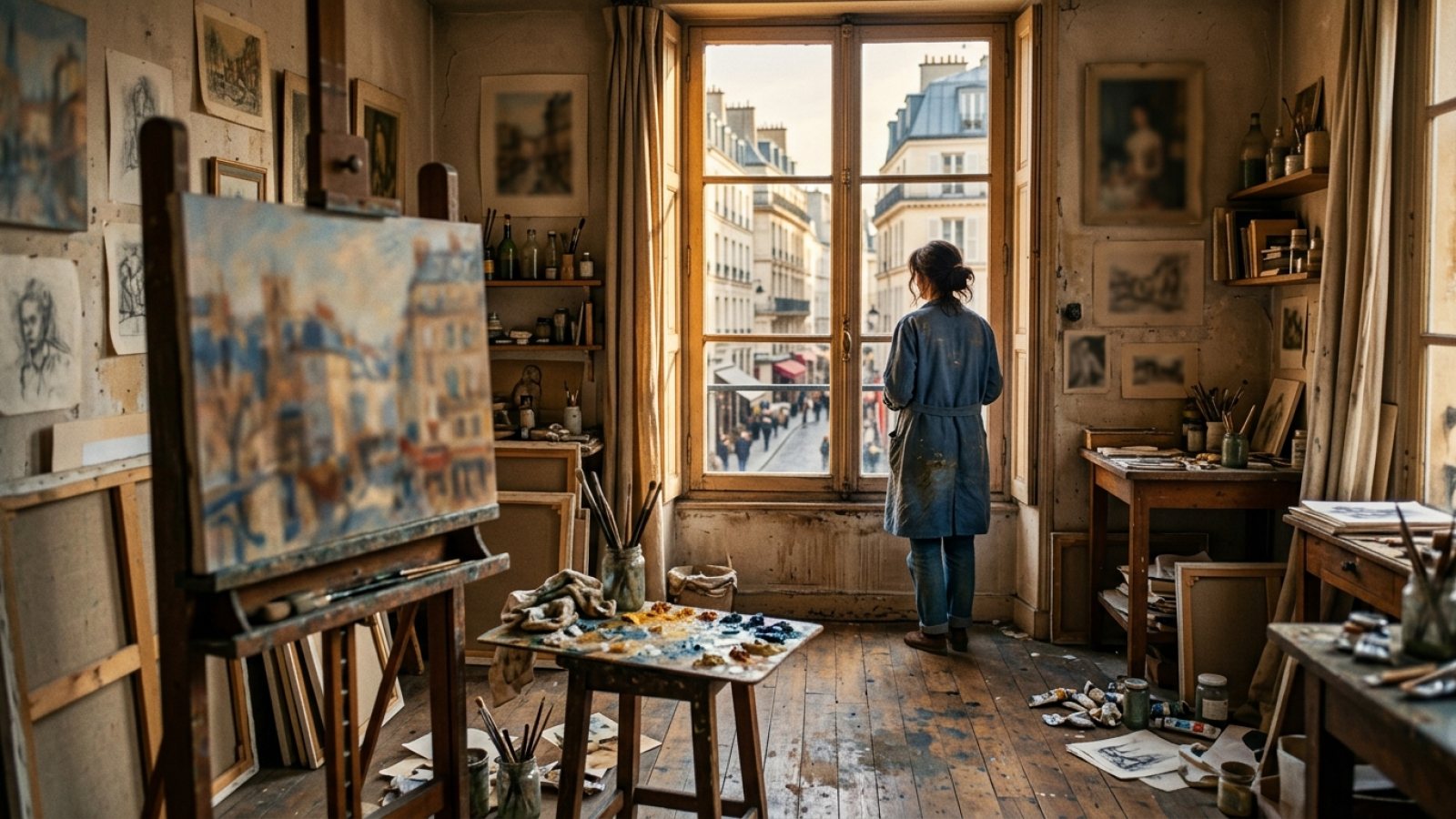
Montmartre is a neighborhood that practically demands to be painted, if only because it has spent the last century posing for us. In Jean-Pierre Jeunet’s beloved 2001 cinematic confection, Amélie (released in France as Le Fabuleux Destin d'Amélie Poulain), the cobblestone streets and corner cafés are saturated with a golden, hyper-real nostalgia. Yet beneath the whimsical surface of this Parisian fairy tale lies a remarkably poignant meditation on the act of looking. Here at Art Within Art, we live for exactly these moments. What is recursing is a masterpiece of French Impressionism, and it matters because the reproduction ceases to be a mere copy. Instead, it transforms into a psychological mirror, unlocking the film’s central emotional puzzle: a man paints a famous painting, over and over, using the canvas to decipher the living, breathing people outside his window.
The Glass Man’s Obsession
Enter Raymond Dufayel, known to his neighbors as "the Glass Man." Afflicted with a condition that gives him dangerously brittle bones, Dufayel lives a life of extreme caution, padded against the sharp edges of the world. Unable to safely participate in the messy, bustling life of modern Paris, he observes it through a lens instead. But his true life’s work happens at his easel. Once a year, for twenty years, he has meticulously copied Pierre-Auguste Renoir’s 1880-81 masterwork, Luncheon of the Boating Party.
The original Renoir, which currently hangs an ocean away in The Phillips Collection in Washington, DC, is a triumph of Impressionist vitality. It depicts a sun-dappled balcony on the Seine, crowded with Renoir's actual friends chatting, flirting, and drinking. It is a brilliant snapshot of effortless conviviality. How exquisitely ironic, then, that a man who cannot endure the physical friction of a crowded room spends two decades trying to reproduce its exact geometry. For Dufayel, the painting is a controlled substitute for human connection. He knows the strokes, the colors, and the cast of characters intimately, yet there is a singular snag in his grand design.
The Girl with the Glass of Water
Despite his technical mastery of the scene, Dufayel confesses to our heroine that he can never quite get one figure right: the girl with the glass of water. She sits slightly apart from the main action, taking a sip, her gaze drifting away from the boisterous companions surrounding her. She is physically present but emotionally absent. Naturally, Dufayel’s struggle with this specific figure is no accident of brushwork.
As Amélie and the Glass Man discuss the girl in the painting, a delicate transference occurs. They debate the painted woman's motives with the seriousness of gossip columnists. Is she thinking of someone else? Is she afraid to join the fray? It becomes instantly clear that they are not talking about a nineteenth-century Parisian model; they are talking about Amélie herself. Like the girl with the glass of water, Amélie is an observer. She orchestrates the happiness of others from the margins, terrified of stepping into the center of her own life and risking a broken heart.
A Canvas of One's Own
This is where the recursion transcends a clever visual motif and becomes the emotional engine of the film. Amélie is a movie about a young woman who treats real life as if it were an art project, carefully arranging the fates of her neighbors while keeping herself safely out of the frame. Dufayel does the exact opposite. He takes a finished piece of art and treats it like an unsolved mystery of real life. By endlessly repainting the Luncheon of the Boating Party, he is trying to paint his way into an understanding of the human condition.
The beauty of this cinematic choice lies in its mutual salvation. Through the safety of discussing a painted figure, the fragile old man manages to pierce the armor of the young, vibrant woman. He gently forces Amélie to recognize her own reflection in the wet oil paint. In return, her courage to finally pursue her own messy, unpredictable romance allows Dufayel to put down his brush. He has finally figured out the girl with the glass of water. By framing a masterpiece within a masterpiece, Jeunet reminds us of art's highest calling: not to be perfectly copied, but to be fiercely, joyously lived.
